Fill-In Crossword Strategies: How to Solve Any Puzzle
A fill-in crossword gives you all the answers and none of the clues, so solving one is mostly a question of order. Here are the moves that work, from the safest to the riskiest.
Start with the rarest length
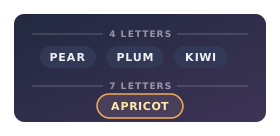
Before you place anything, look at how the word bank is grouped. If there is only one word of a certain length, and the grid has only one slot that size, that placement is free. It cannot be wrong. Long words are usually where you find this: a puzzle might have six four-letter words but just one nine-letter word. Lock those in first, because every certain word turns into crossing letters for its neighbors.
Let the crossings decide for you
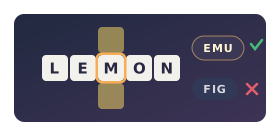
Every cell where two words cross has to work for both of them, and that constraint is the whole game. Once a word is on the grid, read the letters it drops into the slots crossing it. A slot that used to have five candidates often has exactly one word that matches its crossing letter, especially if that letter is uncommon. A J or a V at an intersection usually settles things on the spot.
Work one region at a time
It is tempting to jump to whatever slot looks easy anywhere on the grid, but placements help you most when they touch each other. Each new word feeds letters to its neighbors, so solving outward from a solved corner keeps handing you new information. Scattered placements leave you with a grid full of lonely words and no crossings to reason from.
Stuck? Count candidates for one slot
When nothing looks certain, pick one slot and count what could actually go there. Length does most of the filtering: a nine-cell slot only cares about the nine-letter words, so you are usually choosing between a handful of candidates, not the whole bank. A slot with two candidates and one crossing letter is nearly always solvable right now. A slot with ten is not worth staring at yet.
Guess late, and guess where it is cheap
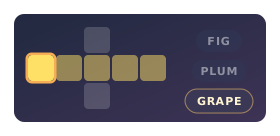
On harder puzzles, deduction alone will eventually run dry and you will have to try something. Two things make a guess cheap. First, guess in a slot with many crossings: if the word is wrong, the letters it feeds into neighboring slots will stop matching almost immediately, and you will know within a word or two. Second, remember which word you guessed. When a contradiction appears, that guess is the first suspect.
Erase early, not late
A wrong word rarely announces itself right away. What you usually notice is smaller: a crossing slot where none of the remaining words fit. When that happens, resist the urge to keep forcing words in around the problem. Clear the guess and its neighbors and rebuild from what you are still sure of. Backing out two words early is quick. Untangling six words later is not.
Cross off words as you place them
Wherever you solve, keep the word bank tidy: strike out every word the moment it goes on the grid. Counting candidates only works if the words you scan are genuinely still available, and one placed word left unstruck will send you chasing options that do not exist. On paper, a pencil beats a pen for the same reason: erasing has to stay cheap.
Difficulty changes the plan
Easier fill-ins are built so pure deduction is always enough: at any moment some slot has exactly one candidate, so being stuck means you missed something and it pays to recount. Harder puzzles use fewer word lengths and bigger candidate groups, and the toughest expect a guess from the very first move. The harder the grid, the more the cheap-guess and early-erase habits matter.
Try it on a real puzzle
The fastest way to make these habits stick is a few puzzles a day. You can play a free fill-in crossword puzzle online right here, with three difficulty levels and a fresh puzzle every game.
Ready to put the strategy to work? Start on Easy to practice the deduction, then see how far you get on Hard.
Play Fill-In Crosswords